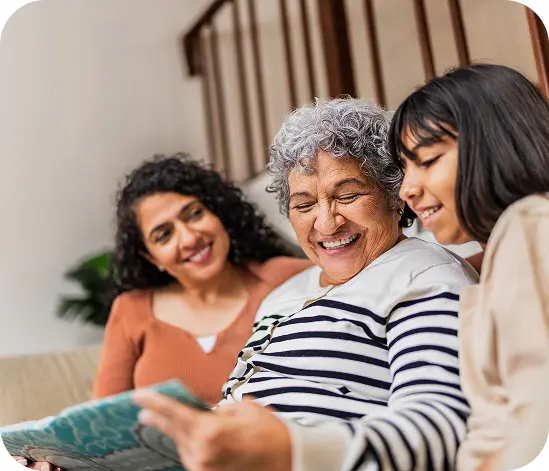


Imagine a grandmother in the San Gabriel Valley raising her two grandchildren alone. She stepped in when their parents could no longer be present, not a choice she planned for, but one she made without hesitation. She works part-time, stretches every dollar, and loves those kids fiercely.
But lately, things are unraveling at once. The landlord raised the rent. Her grandson’s school called again about his behavior in class. Her granddaughter stopped eating regularly. She missed a medical appointment because she couldn’t get a ride and didn’t know who to call. And somewhere underneath all of it, she’s carrying grief she hasn’t had time to name.
From the outside, this looks like a housing problem. Or a behavioral health problem. Or a transportation problem.
From the inside, it’s all of them, arriving at the same time, with no clear door to walk through.
This is the reality for thousands of families across Los Angeles County — and particularly in the San Gabriel Valley, where housing costs, cultural and linguistic barriers, and gaps in mental health access converge in ways that no single referral can address. The question isn’t whether families need help. It’s whether the system is designed to meet them where they actually are.
“From the outside, it looks like a housing problem. From the inside, it’s all of them, arriving at the same time, with no clear door to walk through.”
Housing Instability Is a Health Crisis — Not Just a Housing Crisis
When families lose stable housing or spend years on the edge of losing it, the effects don’t stay contained to the home. They move into schools, into pediatricians’ offices, into a child’s ability to concentrate or trust, or sleep.
Research published in Pediatrics by the American Academy of Pediatrics found that housing instability is associated with significantly increased odds of poor child health, elevated caregiver depression, and greater risk of hospitalization — even when controlling for income and other socioeconomic factors. In that study of more than 22,000 families, one in three reported at least one form of housing hardship in the past year.
A 2025 study published in JAMA Network Open found that caregiver stress about eviction or housing loss was directly associated with increased odds of depression in children, with younger children showing the strongest effects.
And in Los Angeles County specifically, the connection between housing insecurity and behavioral health outcomes is well-documented. LA County’s own public health research has found that housing instability is associated with behavioral issues in children, increases in adolescent depression, and a range of acute and chronic health consequences that persist long after a family finds a safer place to live.
For families in the San Gabriel Valley, these pressures are layered onto a region already navigating significant gaps. The Greater San Gabriel Valley Community Health Snapshot identifies behavioral and mental health, housing and homelessness, and economic insecurity as the region’s top interconnected concerns and notes that mental health services remain out of reach for many residents due to cost, language, and cultural barriers.
The problem isn’t that families don’t want support. It’s that the support has rarely been designed to address everything at once.
What Enhanced Care Management Actually Does
California’s Enhanced Care Management (ECM) program was built on a simple but transformative premise: for families with the most complex needs, one care manager who knows the whole picture is more effective than five separate referrals to five separate systems.
ECM is a statewide Medi-Cal benefit — available at no cost to eligible members — that provides person-centered, community-based care management for people navigating multiple, intersecting challenges at once. As of mid-2025, more than 276,000 Californians have received ECM services statewide.
Under ECM, a Lead Care Manager works with the family — not just the patient — to understand what’s actually happening across housing, behavioral health, physical health, and basic needs. They coordinate with doctors, schools, county agencies, and community-based organizations. They accompany families to critical appointments. They help navigate Medi-Cal benefits, arrange transportation, and connect families to services they didn’t know existed.
ECM is designed specifically for families who are:
- Experiencing housing instability or homelessness
- Living with serious mental health conditions or substance use disorder
- Involved with child welfare or foster care systems
- Frequently utilizing emergency departments due to unmet needs
- Navigating multiple complex health and social circumstances simultaneously
In other words, families like the grandmother in the San Gabriel Valley who isn’t in a single crisis — she’s in several, all at once.
ECM doesn’t replace the programs families need. It connects them — ensuring that a family who needs temporary housing support, behavioral health services, and school-based resources isn’t left to navigate each system alone.
“ECM doesn’t replace the programs families need. It connects them — ensuring that a family navigating housing, behavioral health, and school-based needs isn’t left to navigate each system alone.”
What Whole-Person Care Looks Like in the San Gabriel Valley
Understanding ECM as a framework is one thing. Seeing it in practice — in a community with the specific cultural, linguistic, and geographic realities of the San Gabriel Valley — is another.
This is where Connections by Maryvale enters the picture.
Located in Duarte and serving communities across the San Gabriel Valley, Connections by Maryvale is an integrated behavioral health program built on the belief that mental health, substance use recovery, and family stability cannot be treated as separate tracks. The program works in close partnership with LA County Department of Mental Health (DMH) and delivers services that meet people where they are — in their communities, in their schools, in their homes.
Current services include:
- Enhanced Care Management (ECM) — coordinated, person-centered care management for Medi-Cal members with complex needs, delivered by a dedicated Lead Care Manager who works across systems on behalf of the family
- Substance Use Disorder (SUD) services within school communities — bringing prevention, early intervention, and recovery support directly into the school settings where young people already are
- DMH partnership programs — connecting families to county mental health resources through trusted, community-embedded relationships
The SGV’s cultural diversity is a strength — and it requires a response equal to it. Research on the SGV’s behavioral health landscape consistently points to the need for culturally responsive, bilingual care as a prerequisite for meaningful access. Connections by Maryvale delivers services in English and Spanish, and works within the cultural contexts of the communities it serves.
When Families Also Need a Safe Place to Land
Whole-person care has to start somewhere and for some families, the most urgent need is a roof that isn’t at risk of disappearing.
Housing instability doesn’t disqualify a family from behavioral health support. But it does make everything else harder to hold. When caregivers are managing the threat of displacement, children’s behavioral and emotional needs often go unaddressed — not because anyone has given up, but because survival takes precedence.
For families who need temporary housing as part of their path toward stability, Maryvale’s Seton House program provides a structured, supportive environment where mothers and children can access the time, resources, and wraparound services needed to rebuild. Seton House offers temporary housing combined with individualized case management, parenting support, life skills development, and connections to community resources — addressing immediate safety needs while building toward lasting independence.
Temporary housing and behavioral health care are not either/or. For many families, they’re the beginning of the same journey.
Why Coordination Is the Missing Piece
Families in crisis rarely have only one need. And yet, until recently, the systems meant to serve them were largely organized around single problems: a housing agency, a mental health clinic, a substance use program, a school counselor — each doing meaningful work in isolation, with little infrastructure to share information or coordinate care.
ECM and integrated programs like Connections by Maryvale represent a shift in how that infrastructure is built. Rather than waiting for families to find their way through a fragmented system, these models send a Lead Care Manager into the community to build trust, assess the full picture, and coordinate care across every relevant system — from Medi-Cal managed care to LA County DMH to local school communities.
For the San Gabriel Valley, where stress related to economic insecurity and social isolation is the primary driver of behavioral health need, and where cultural and linguistic barriers create additional distance between families and care, that kind of relationship-centered coordination isn’t a luxury. It’s the mechanism through which care actually reaches the people who need it.
California has invested significantly in this direction. Following the passage of Proposition 1 in 2024, the state has awarded $2.9 billion in behavioral health capital infrastructure grants across 111 projects — expanding residential and community-based treatment capacity throughout LA County. ECM is the care coordination layer designed to connect families to that expanding infrastructure.
The pieces are coming together. The work is connecting them at the family level.
Maryvale’s Commitment to the Whole Family
For more than a century, Maryvale has served children, youth, and families across Los Angeles County — not by addressing one need at a time, but by showing up for the whole person, in the full complexity of what they’re carrying.
Through Connections by Maryvale, that commitment extends into the San Gabriel Valley with programs specifically designed for the community’s needs: ECM coordination for families with multiple intersecting challenges, SUD services embedded in school communities, and DMH partnerships that bridge clinical and community-based care.
Through Seton House, Maryvale provides temporary housing and wraparound support for mothers and children who need a stable foundation before anything else is possible.
And through its broader network of programs across LA County, Maryvale continues to build the kind of whole-person care infrastructure that families like the grandmother in our opening story have always deserved — and are finally beginning to access.
If you’re a family member, caregiver, healthcare provider, or community partner looking for coordinated support in the San Gabriel Valley, we’d like to connect.
Frequently Asked Questions
What is Enhanced Care Management (ECM)?
ECM is a no-cost Medi-Cal benefit that provides coordinated, whole-person care management for members with complex health and social needs. An assigned Lead Care Manager works with you across healthcare, behavioral health, housing, and community services so you’re not navigating each system alone.
¿Qué es el Manejo de Atención Mejorada (ECM)? / What is ECM in Spanish?
El Manejo de Atención Mejorada (ECM) es un beneficio de Medi-Cal sin costo para miembros con necesidades complejas de salud. Un coordinador de atención trabaja con usted y su familia para conectarle con los servicios de salud, salud conductual, vivienda y recursos comunitarios que necesita. / Enhanced Care Management is a no-cost Medi-Cal benefit for members with complex health needs. A care coordinator works with you and your family to connect you with the health, behavioral health, housing, and community resources you need.
Who qualifies for ECM through Connections by Maryvale?
ECM is available to Medi-Cal members who are experiencing housing instability, have serious mental health or substance use needs, are involved with child welfare systems, or are frequently using emergency services due to unmet needs. Contact our team to learn whether you or someone you support may qualify.
What is temporary housing, and how is it different from emergency shelter?
Temporary housing programs like Maryvale’s Seton House provide a structured, supportive environment where families can stay while accessing wraparound services including case management, parenting support, and resource connections as they work toward long-term stability. Unlike emergency shelters, temporary housing is designed to provide enough time and support for lasting change.
How do I refer a family to Connections by Maryvale?
Healthcare providers, school staff, DMH partners, and community members can reach our team through the Maryvale contact page or directly through mvconnections.org. We welcome referrals and are available to discuss the right fit for the families you serve.
Sources
- Sandel M, et al. “Unstable Housing and Caregiver and Child Health in Renter Families.” Pediatrics, American Academy of Pediatrics, 2018. Read the study
- Hanson JL. “Stress About Eviction or Loss of Housing and Child Mental Health.” JAMA Network Open, 2025. Read the study
- LA County Department of Public Health. “Social Determinants of Health: Housing and Health in Los Angeles County.” Read the report
- LA County Department of Public Health. “Greater San Gabriel Valley Community Health Snapshot.” Read the report
- California DHCS. “Enhanced Care Management.” CalAIM Transformation. Learn more
- Office of Governor Gavin Newsom. “Governor Newsom Announces Major Transformation of Six Vacant Buildings in LA County into Mental Health and Housing Communities.” March 2026. Read the announcement